TIME CHANGES ALL
I knew Karijini National Park had an ancient landscape. I’d seen pictures of canyons that were carved out by floods. Satellite images of rolling plains with fractal-like canyons. Paintings of ghost gums that cling to cliffs.
It wasn’t until I stood on Country that I truly felt deep time in the landscape.
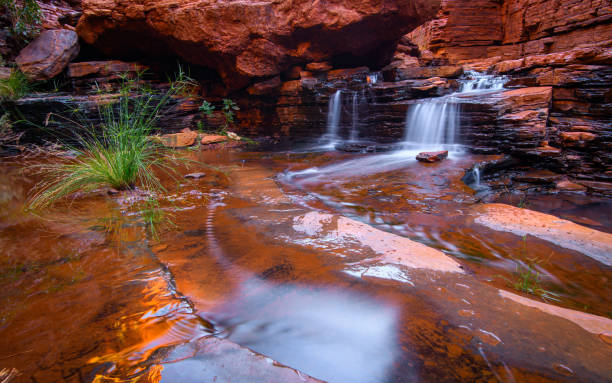
After scrambling down the scree slopes, I saw the creeks which created the gorges. They tumbled and trickled at times. They continued to flow down and on. They left their mark rock by rock, grain by grain.
After a few breaths, I paused on distant ridges and noticed the web of life all around me. The tiny wildflowers carve out a life in the stony ground underfoot. The remote calls of parrots and cockatoos. The burnt gums from endless cycles of fire, rebirth, and death.
Karijini, the traditional homeland of the Banyjima and Kurrama peoples, is a landscape worth appreciating over millennia rather than minutes.
In August 2022, I spent a whole week photographing the area with my father. Every year, we take a photo journey. We have done everything from chasing the autumn colors in Tasmania to hiking around the snow-capped mountains of New Zealand.
We’ve never been further than this year. After experiencing Karijini, I am certain that this trip will not be the last thing I see.
A Trip Without an Itinerary
I met Dad in Perth. After a walk through Kings Park, where the native wildflowers were in full bloom in a patchwork pattern of colors, we flew to Paraburdoo. Karijini was our only destination, and we were the only FIFO tourists on a plane full of FIFO miners.
Our holiday plans were over once we picked up the rental car.
It was the first time I had not researched and planned a list of scenic spots for each day. I knew Karijini had many, of course. But I was more flexible to see how the roads and ridges took us. Why?
People don’t fail because they plan. They don’t plan.
He loves spreadsheets and uses them for trip planning, calculating daily travel distances, and creating packing lists.
This is a piece of advice I have taken with me throughout my entire life. We planned the trip well in advance, including our flights, cars, and accommodations. We then stocked up in town on food and fuel – banana bread, coffee, and chocolate are now essentials for trips – before heading out to the bush.
Why not stick to the main purpose of your trip, like knowing the best scenic lookouts and hiking trails for photography?
Maybe I had a greater trust in my abilities as a photographer to capture scenes exactly as they appeared. Perhaps I realized that the weather can change quickly, so it’s necessary to rethink locations as needed. Maybe I’ve just become more comfortable with uncertainty in the past two years.
SEARCHING AND SCOPING
We drove to Knox Gorge for our first sunrise session well before dawn. We walked to the lookout and took some pictures down the gorge.
The central gorge was not my favorite part of the landscape. Rich red cliffs glowed in the evening light. The ghost gums’ smooth bark stands out against the rough scrub. The spinifex puffs are not so fluffy. I decided to walk up the gorge and see what else was there.
Through a lucky accident, I came across what would become one of my favorite frames from the trip.
Three ghost gums were perched below the cliff edge on a ledge. The morning light illuminated the arthritic legs against the crumbling rock. Click. I was on the move.
We booked six nights in the Karijini eco-resort. In previous trips, Dad would spend two or three days at one location before moving on to another to see as much as possible.
We spent more time searching and scouting the landscape in order to gain a better understanding of the area. We would check out the main lookouts and gorges during the daylight hours. Once we had a good idea of where we were, we took note of any sights that caught our attention and returned later in a better light.
We walked through Weano Gorge first and then scouted out Hancock Gorge. We scrambled through loose scree to Knox Gorge, where we saw Sauron’s glowing eye at the end. We drove east to see Dales Gorge and the reflections of Fern Pool in the lush vegetation.
I treasured the memories and scenes that awaited me beyond the main attractions.
Finding beauty beyond the worn-out path
We had a rhythm to our days. I would ask Dad to stop when he drove past a striking gum or gully.
We went into the bush with a pair of knee-high gumboots for pushing through the scrub and a personal locator device (just in case).
We walked through a patchwork of wildflowers and spinifex. We scrambled to the top of ridges, where slate and stones were used as soil.
We would head to the slender tree or the boulder-strewn ravine, thinking that we had found a hidden treasure of a picture.
But half of the time, our hopes for a beautiful photo are dashed.
The vantage point is often too low, and the tree appears against a bright sky. Or charred stumps would distract from the human subjects. If you look closely, the scene is not spectacular but average.
Our oohs and Ahhs from the first day to this new landscape soon faded away into Meh by day six. The vast beauty of this land was evident, but it didn’t take long for nice to become the norm. (I think there’s a deeper lesson in this.)
Our wanderings have struck gold the other half of the time.
We would return to the scene the following morning in the early dawn light with our headlamps and set-up tripods. We would then wait for the sun to rise and a soft glow to spread across the landscape.
PLANNING PLAYED AN IMPORTANT PART
We found some of our best frames in the main gorges, but we were also able to capture some memorable shots at unnamed gullies or distant trees.
Planning and preparation allowed us to create images that were more than just casual snapshots.
I found the best focal lengths and vantage points by arriving early to scope out the scene and assess it in daylight. I rarely used my wide-angle 16-35mm lens; instead, I reached for my 70- 200mm telephoto when shooting distant details. I also used Photopills or Windy apps to track the incoming clouds and predict how the sun would angle itself down each canyon.
We used these tools to plan the photos we took. We knew which gorges were best to visit during sunrise and which at sunset. We knew which gorges to visit at sunrise and sunset, as well as on what day a cloud front was passing overhead.
The conditions were exactly as predicted.
Knox Gorge had one of the most intense dawns I have ever seen. The evening view of Dales Gorge was equally stunning: leading lines, twisting tree branches, peaceful reflections, and a sky that matched.
FINDING EQUALITY IN THE SMALLER MOMENTS
The smaller moments have become more important to me than the big vistas. My sixty-year-old father and I would climb steep ridges before dawn.
We were amazed at the variety of wildflowers that we found. Fluffy pink-purple mulla mullas. Golden wattle blooms. The magenta paper daisies and the vibrant magenta wattle blooms all stood out in contrast to what was not so lifeless scrub around us.
The quiet moments in between. After a sunrise photo session, Dad and I would sneak away for a barista-made coffee at reception to soak up the sun.
The trip showed the importance of finding that Goldilocks Zone between meticulous planning and winging it.
We would have missed many small scenes if we had followed a strict timetable. If we had left it to chance, we would have been in the wrong spot at the bad moment when the sky burst into color.
I like to be prepared. When surprises happen, I take them in stride. The joy of discovering unexpected things and overcoming obstacles is much more memorable.